
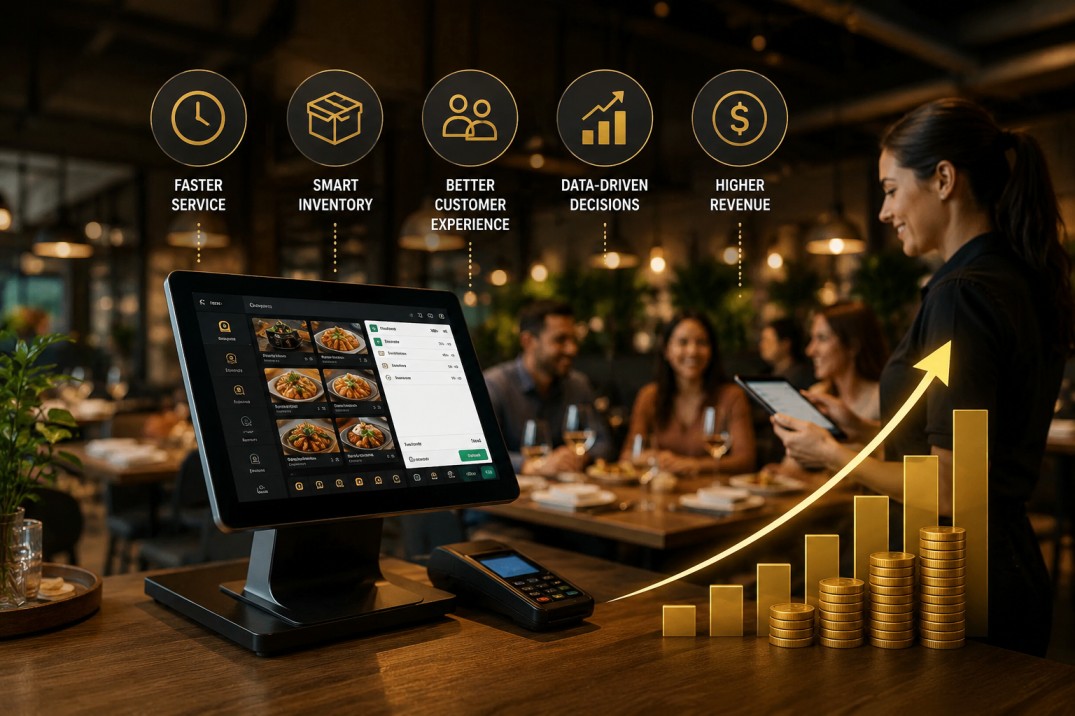
Raising menu prices is the most obvious lever a restaurant can pull when margins tighten. However, this move can push loyal customers toward the competition. The smarter play is extracting more value from every existing transaction, every table turn, and every operational hour you already have. A well-configured restaurant POS in Dubai does exactly that- quietly and consistently, and with this, you don’t need to rely on a single price increase on your menu. This guide walks through every mechanism that makes it possible, and the sections on upselling and data intelligence are worth reaching the end for.
What a Restaurant POS Actually Does
A restaurant Point of Sale system is the central technology platform that processes orders, manages payments, tracks inventory, and generates operational data across a food and beverage business. Modern POS systems go well beyond transaction processing- they function as revenue management tools that influence customer behaviour, staff performance, and business decision-making simultaneously from a single integrated platform.
The Revenue Mechanisms Most Restaurant Owners Underuse
Intelligent Upselling Built Into the Order Flow
A POS system that prompts staff with smart upsell suggestions at the point of order entry is one of the most direct revenue tools available. When a server enters a burger, the system surfaces a paired side or premium drink automatically. Multiply that incremental addition across every order on a busy Friday evening, and the revenue impact becomes significant without a single price change or sales training session.
Faster Table Turns Through Reduced Order and Payment Friction
Every extra minute a table is idle between courses or waits for a bill is the revenue the next booking cannot generate. A well-configured POS sends orders to the kitchen instantly, flags long-pending tables, and enables tableside payment that eliminates the bill-request delay entirely. Restaurants that reduce average table time by even ten minutes per cover across a full service genuinely change their weekly revenue ceiling.
Menu Engineering Powered by Real Sales Data
Not all menu items earn equally. So with the right POS system, you can track exactly which dishes sell, which stall, and which generate the highest margin. This data allows restaurant managers to redesign menu layouts, feature high-margin items more prominently, and quietly retire dishes that cost more to produce than they return. Decisions made on actual sales data consistently outperform decisions made on intuition or chef preference alone.
Loyalty Programme Integration That Brings Customers Back
A POS with integrated loyalty functionality automatically tracks:
- Visit frequency
- Spending patterns
- Reward eligibility
Customers enrolled in a points or reward structure visit more often and spend more per visit than those without loyalty incentives. The POS makes this programme invisible to staff while keeping it consistently active for every transaction.
How NCR POS Technology Handles High-Volume Service Environments
Enterprise-grade systems such as NCR POS in Dubai are built specifically for environments with high volume, where transaction speed, system stability, and multi-terminal synchronisation cannot be compromised. In a busy restaurant during peak service, a system that slows down or loses table data is not just inconvenient- it costs covers, tips, and reputation. Robust POS infrastructure is the foundation everything else on this list depends upon.
Inventory Tracking That Eliminates Silent Losses
Over-portioning, spoiling, and unreported waste all contribute to food cost leakage that reduces margin without being visible anywhere on a P&L. Real-time tracking of ingredient usage against sales is done using a point-of-sale system connected to inventory management. With this, any disparities that indicate waste or theft are flagged. No menu pricing increase has the same clear impact on the bottom line as recovering even a two percent improvement in food costs over the course of a month’s trade.
Self-Service Technology That Increases Average Order Value
Customer-facing ordering technology consistently produces higher average spend than staff-taken orders. When guests browse and select without time pressure or perceived social awkwardness, they add extras, upgrades, and desserts more readily. A self-checkout system in Dubai integrated with the restaurant’s POS captures this behaviour systematically, increasing ticket size while simultaneously reducing the labour pressure on front-of-house staff during peak periods.
Reporting That Turns Operating Hours Into Strategic Decisions
A POS that generates detailed hourly, daily, and weekly performance reports offers the managers and owners the visibility to make staffing, purchasing, and promotional decisions based on patterns instead of guesswork. Identifying the two slowest hours of a Tuesday service and running a targeted promotion specifically for that window is only possible when the data exists to confirm the problem and measure the result.
The Bottom Line
Revenue growth in a restaurant does not always require charging more. It requires using what you already have more intelligently- faster turns, smarter upsells, tighter inventory, and loyalty that compounds over time. Every mechanism covered in this guide becomes more consistent and more measurable with the right technology behind it. A properly implemented restaurant POS in Dubai is not an operational expense. It is a revenue infrastructure investment that pays back across every single service, without touching a single price on your menu.
FAQs
How long does it typically take to see a measurable revenue impact after implementing a new restaurant POS system?
Most restaurants report measurable improvements in table turn times and average transaction values within the first four to six weeks of consistent use and proper staff training across all service positions.
Can a restaurant POS integrate with third-party delivery platforms without creating double-entry or order management problems?
Yes, most modern POS platforms offer native or API-based integrations with major delivery aggregators, centralising orders from all channels into a single kitchen display and reporting view without manual duplication.
What staff training is required to get the full revenue benefit from a new POS system?
Front-of-house staff need training on upsell prompts, table management features, and payment processing. Managers, on the other hand, need
- Deeper training on reporting
- Inventory reconciliation
- Loyalty programme administration.
Is a cloud-based POS more effective for revenue management than a traditional on-premise system?
Cloud-based systems offer real-time reporting accessible from anywhere, automatic updates, and easier multi-location management, which generally makes them more effective for data-driven revenue decisions than legacy on-premise alternatives.
How does a POS system help reduce revenue loss from staff errors or unrecorded transactions?
By requiring every order to be entered before preparation begins and every payment to be processed through the system, a POS creates an auditable transaction trail that makes unrecorded sales and order errors significantly harder to sustain.
